We keep asking: "What should we build?"
The Slides — Founding Vision (7 slides)
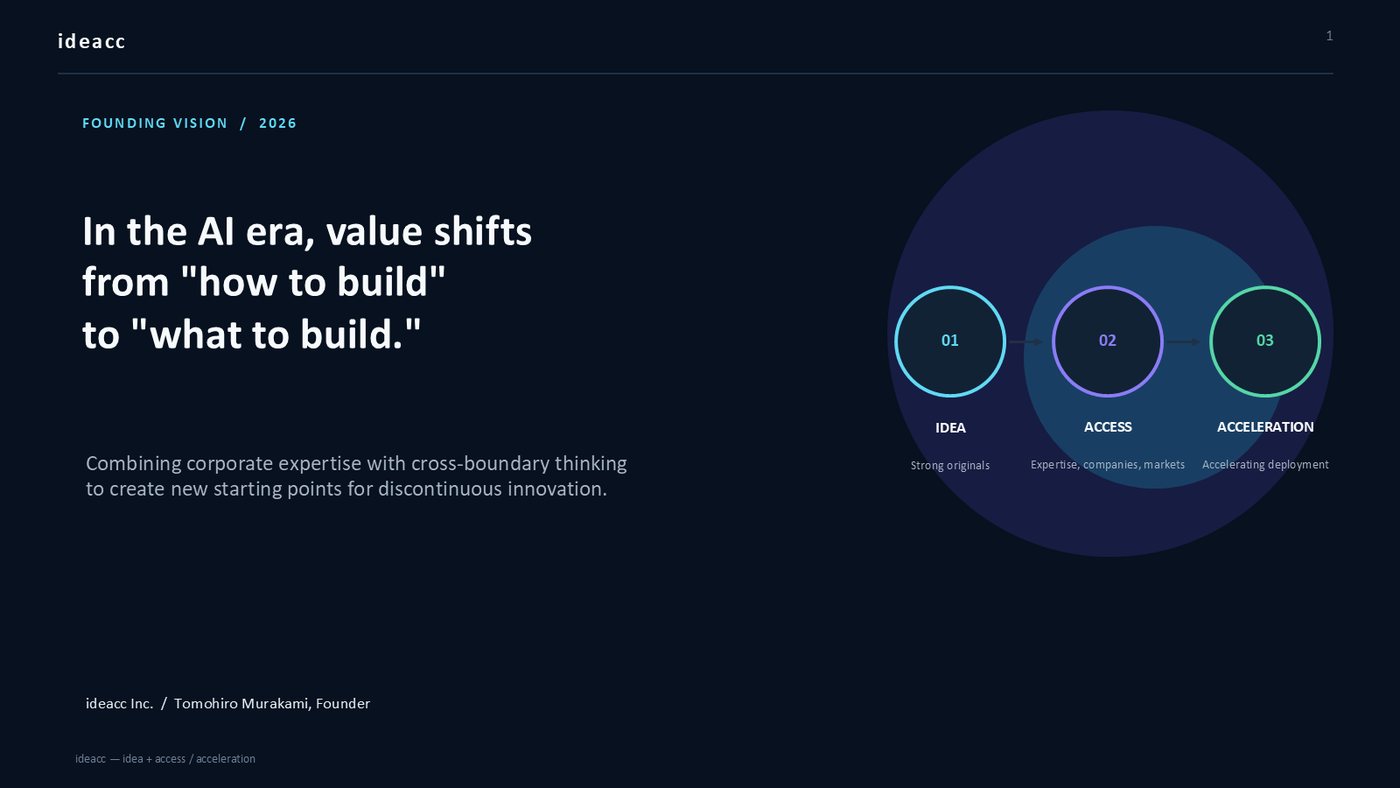
We are standing at the entrance to an era in which the rapid evolution of AI is transforming the very nature of technology development and innovation.
There was a time when assembling talented engineers and investing time and money to build a system was itself a major source of competitive advantage for a new business. With the evolution of generative AI, however, many implementation skills—programming chief among them—are rapidly being opened up to everyone.
Of course, advanced engineering, and the ability to bring a product to mass-production quality, will not lose their importance. Yet the scarcity of "being able to implement" will steadily decline.
The same change is happening in the world of ideas. Ask an AI about typical new businesses or services, and you can obtain dozens or hundreds of ideas in a short time. Simply producing many ideas will therefore no longer be enough to stand out.
That is exactly why we believe that in the AI era, the value of
and
"How strong a principle or concept can we create—one that does not lie on the extension of the past?"
will rise higher than ever.
Incremental Improvement and Discontinuous Innovation
Large companies have exceptionally talented people and experts across many fields. In development that improves existing products and services by a few percent—or a few tens of percent—their accumulated expertise, experience, data, equipment, and customer understanding are enormously powerful. This is the overwhelming strength of large companies.
On the other hand, discontinuous innovation—creating several-fold or even tenfold differences in performance or cost and changing the very premises of existing markets—does not necessarily emerge from digging ever deeper within a single specialty.
Rather,
great leaps often come from what lies between seemingly unrelated technologies and industries—
We believe these boundary domains hold enormous possibilities.
The "Depth" of Experts and the "Crossing" of ideacc
Experts are indispensable for realizing revolutionary technology. But at the stage of conceiving the first idea or concept, being the most knowledgeable in a single domain is not always an advantage.
The deeper one's expertise, the more one accumulates highly valuable knowledge about what is common sense in that field, what is difficult, and how things are normally designed. Yet when conceiving an entirely new structure, it is sometimes necessary to step away from that common sense.
Crossing these boundaries—and connecting technologies already established in other fields to different problems—is where discontinuous thinking can arise.
ideacc does not aspire to be an expert in every technical field. Rather, our role is to avoid being confined to any single specialty: to re-frame many technologies in terms of "what can this technology do?", to move across different fields, and to discover new combinations.
Then, once a new concept is born, we discuss it with corporate experts holding world-class knowledge in that field, evolving the technology into something deeper and more practical.
We believe there is great value in
New Options Visible Only from the Outside
The technology, equipment, supply chains, and customer bases that companies have built over many years are assets that cannot easily be replicated. At the same time, the more successful an existing business is, the more natural it becomes to conceive next-generation technology on the premises of the current architecture.
Precisely because ideacc stands outside the company, we can start from questions such as:
What we want to provide is not a replacement for corporate R&D. It is a new starting point—different from the extension of what is already inside the company.
The company's experts then evaluate, refine, implement, and take that starting point to the global market. Through this combination, innovations emerge that neither the company alone nor ideacc alone could have produced.
Another Possibility for Startups
At the same time, we see a new possibility for how startups in Japan can work.
Today's startup ideal tends to demand everything from a single founder: discover the problem, conceive the idea, raise funds, build the team, develop the product, sell it, and grow the company—a "singer-songwriter" model of entrepreneurship.
But a person with outstanding execution ability is not necessarily a person who produces revolutionary inventions. Conversely, someone who produces superb inventions need not excel at fundraising, management, and sales all at once.
In music and film, the division of roles among composers, screenwriters, producers, and performers is taken for granted. We believe startups deserve the same kind of division of labor.
ideacc also wants to be the provider of the "original story" ideas that make this possible.
Turning Ideas Themselves into Valuable Intellectual Assets
The ideas we speak of are not mere flashes of inspiration. We:
Where needed, we go on to consider manufacturing methods, system architecture, business models, and applications. Only by going that far does an idea become an "intellectual asset" that companies can evaluate.
In software, platforms like GitHub have created a culture of building new work on top of past achievements. In the world of ideas, however, most people still start from zero every time.
Technology and invention, too, can accumulate existing knowledge as functions, transfer them across fields, combine them, and evolve them into new inventions. AI has dramatically expanded that possibility.
What ideacc Provides
ideacc is neither a contract developer nor a typical consulting firm.
What we want to provide is
We examine them as technology, shape them into intellectual property, advance them to prototyping and verification where needed, and deliver them to the companies best able to realize their value.
For companies: an "external invention engine" offering perspectives different from
in-house R&D.
For startups: a "source of original stories" enabling new ventures without having to
invent from zero.
We want to be both.
idea + access / acceleration
The name ideacc carries two meanings:
From an idea, access the necessary technology. Access specialized knowledge. Access companies and researchers around the world. Then accelerate that idea until it becomes intellectual property, becomes a product, becomes a business, and reaches society.
Precisely because AI is rapidly spreading the "power to build," the most important question from now on is
ideacc will keep thinking about that "what to build."
Not just the extension of existing technology. Not just one industry. Not just one specialty. We search the under-explored territory between technologies for new possibilities.
And together with companies and people around the world who have the power to realize them, we will grow those possibilities into innovations that make an impact on society and industry.
That is why ideacc was founded.